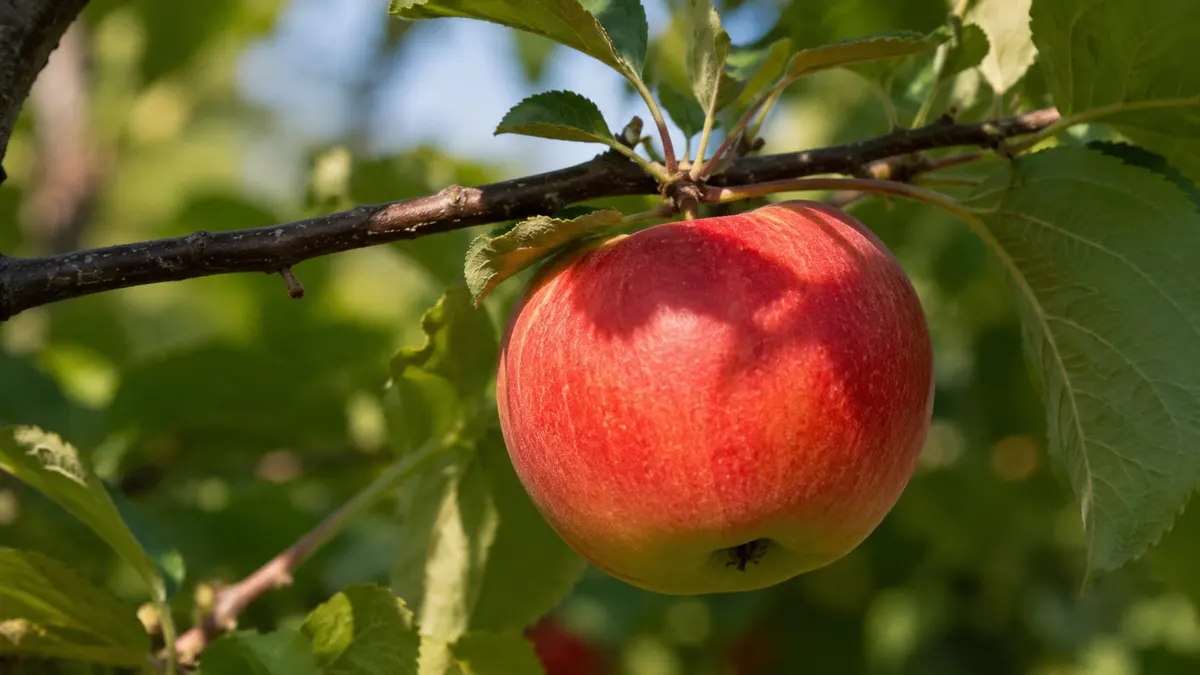
You planted a semi-dwarf apple three springs ago. The leaves come in healthy. The branches look fine. Maybe you got a flush of blossoms one spring. But the fruit just isn’t happening, or what does set drops to the ground in June and lies there rotting. If you’ve been searching for why your fruit tree isn’t producing fruit, you’re in good company. It’s one of the most common frustrations in home orcharding, and the reasons usually aren’t mysterious. They’re just stacked on top of each other.
I’m going to walk through every real cause I can think of, in roughly the order they show up. Most home gardeners are dealing with two or three of these at once, not one. Diagnosing fruit trees is rarely about finding the cause. It’s about ruling out four of them.
Disclosure: Some product links in this article are affiliate links, which means Plant by ZIP may earn a commission if you buy through them at no extra cost to you.
You don’t have a pollination partner
This is the cause people miss most often. A tag at the nursery says “self-fertile” and the homeowner takes that to mean self-sufficient. It rarely does. Even varieties labeled self-fruitful (most peaches, most sour cherries, some apples like Granny Smith and Golden Delicious) crop dramatically better with a compatible second tree blooming nearby. And most apples, almost all pears, most sweet cherries, and nearly all plums need a different cultivar that blooms at the same time and sits within about a hundred feet.
If you have one Honeycrisp standing alone, that’s your answer right there. Honeycrisp is a notoriously poor pollen donor and a needy receiver. You need something like a Fuji, Gala, or Liberty blooming alongside it. For pears, a Bartlett wants a Bosc or D’Anjou. For sweet cherries the old rule was that you needed a separate cultivar, but newer self-fertile selections like Stella and Lapins exist now and do work if you only have room for one tree.
The second piece of pollination is bees. If your yard is mostly turf and your blooms open during a cold, rainy week, no pollen gets moved. Plant something with early flowers nearby. Crocus, willow, dandelion (yes, dandelion), and ground-hugging clover all bring in early pollinators. A mason bee house with replaceable nesting tubes tucked into the orchard area gives solitary bees a place to nest, and they fly in cooler, wetter weather than honeybees do.
The tree is too young, or too vigorous, or both
A standard apple may take 6 to 10 years to fruit. A semi-dwarf, 3 to 5. A dwarf on M9 or Bud9 rootstock, 2 to 3. If your tree is on a vigorous rootstock, three years old, and you’ve been feeding it lawn fertilizer, it’s putting everything into wood and leaves. There’s nothing wrong with it. It’s just not ready.
You can hurry a slow tree along with two techniques. First, stop fertilizing with nitrogen entirely until you see fruit set. Second, bend young scaffold branches toward horizontal with weights or soft ties. Horizontal branches set flower buds. Vertical branches make wood. This is a useful piece of orchard mechanics that many beginners miss. Tree limb spreaders and clothespin-style branch weights are cheap and work better than people expect.
Your pruning is wrong, in one of two directions
Most home gardeners either prune nothing for five years and end up with a thicket, or they prune ferociously every winter and remove all the fruiting wood. Both produce barren trees.
Apples and pears fruit primarily on short spurs that form on two-year-old and older wood. If you cut back every long shoot to a stub every January, you remove the wood that would have spurred up the following year. If you let the tree go entirely, it shades out its own interior and the spurs that do exist stop flowering.
The practical middle ground is one careful pass in late winter. Remove the obvious wrong stuff (dead, crossing, water sprouts shooting straight up, anything growing inward), open the center to let light reach the lower scaffolds, and shorten last year’s most vigorous shoots by about a third. Leave the rest alone. A pair of sharp bypass pruning shears makes the difference between a clean cut that heals and a torn one that invites disease. Peaches and nectarines play by different rules. They fruit on last year’s wood only, so they do need an aggressive annual cut to keep new shoots coming. Cherries and plums sit between the two.
The bloom is getting frosted
If you’re in a zone with unpredictable spring weather, this is probably half your problem and you may not even know it. A 28-degree night during open bloom kills the flowers. A 32-degree night damages them, and you get pollination but ugly russeted fruit that often drops within a month.
Apricots and Asian plums bloom too early for most of the US east of the Rockies and almost never crop reliably. That’s a variety mismatch, not your fault. Peaches in zones 5 and 6 are a coin flip year to year for the same reason. The fix is partly variety selection (late-blooming peaches like Reliance and Contender are worth considering) and partly active protection on frost nights. A piece of floating row cover or frost cloth tossed over a small tree on a 28-degree night can be the difference between a crop and nothing. For larger trees, an old-fashioned trick works: a 100-watt incandescent bulb hung in the canopy under the cloth raises the temperature inside by several degrees.
You’re feeding the leaves, not the fruit
A lawn next to a fruit tree means the tree is getting whatever you put on the lawn. Synthetic nitrogen pushes leafy growth and suppresses flowering. If your tree looks lush, dark green, and is putting out two feet of new shoot growth a year without flowering, it’s overfed.
Pull the turf back at least to the drip line. Mulch with three inches of wood chips, kept off the trunk by a few inches. Stop fertilizing. If a soil test shows you’re short on potassium or phosphorus, address those specifically. Nitrogen is almost never what a non-fruiting tree needs. A mail-in soil test kit can give you a baseline for pH and major nutrients before you spend money on amendments.
Water at the wrong time
Fruit set happens during bloom, but the size and retention of that fruit gets decided in the six weeks after. A drought stress in late May or June causes what orchardists call June drop, where the tree aborts fruit it can’t support. The tree looks fine. The fruit just disappears.
A young fruit tree needs about 10 to 15 gallons a week during establishment, delivered slowly. A drip line, or a five-gallon bucket with a small hole in the bottom set next to the trunk, works better than a sprinkler. A simple drip irrigation kit with 1 gph emitters is easier to manage than dragging a hose around every week. Once a tree is established (year four onward for most stone fruit, longer for apples and pears) it can usually find its own water except in true drought. But during the year you’re trying to get a first crop, water it like you mean it.
Borers, fireblight, and the things you didn’t see
Stone fruit (peach, plum, cherry) gets peach tree borer at the base. You’ll see gummy sap and frass at the soil line. The tree limps along for years, flowering sparsely, never really fruiting, then dies. Apples get codling moth and apple maggot, both of which destroy fruit even when set is good. Pears in the South and Midwest get fireblight, which kills bloom clusters back to bare wood and looks like the tree got hit with a torch.
These are real problems and they’re underdiagnosed. If your tree has weird oozing bark, dead branch tips with curled black leaves, or fruit that gets pinpoint holes and rots from the inside, look up the specific symptoms and treat what you actually have. A regional fruit tree pest and disease field guide pays for itself the first time you identify something correctly. Generic “fruit tree spray” off a big-box shelf usually isn’t matched to your specific issue, and a lot of it is fungicide combined with carbaryl, which kills bees during bloom. Skip the all-in-one spray.
A word about the products that don’t help
You don’t need a foliar bloom-booster spray. You don’t need a root stimulator drench. You don’t need mycorrhizal inoculant for an in-ground tree in decent soil. You don’t need a “fruit tree fertilizer spike” jammed in the ground next to the trunk. These are products that move because they sound like they should work. The tree doesn’t need them. What it needs is the things in the sections above.
Compare the next tree before you buy it
If the diagnosis points to variety mismatch, use the plant screener before buying a replacement. Compare bloom timing, hardiness, first output, and pairings on profiles like Liberty apple, Stella cherry, Reliance peach, and Celeste fig. The planting calendar is also useful for checking whether your spring frost window makes early-blooming fruit a gamble where you live.
Bottom line
A non-producing fruit tree is almost always a pollination problem, an age problem, a pruning problem, a frost problem, or a fertility problem. Usually two of those at once. Walk through the list, fix what you can this season, and accept that with fruit trees the honest answer to most questions is “wait one more year and see.” That’s not a dodge. It’s often how fruit trees work, and the sooner you make peace with it, the better your orchard gets.